 Swift Roofing


Condensation in the loft, why it happens
Damp patches and black mould in a loft look like a leak, but in the vast majority of cases the roof covering is completely sound and the real cause is airflow, not water getting in from outside.
It's a natural reaction to see damp or mould in the loft and assume the roof is leaking. In most cases it isn't. Warm, moist air from inside the house rises into the loft space, and if it can't escape through proper ventilation, it turns to condensation on the cold underside of the roof felt, exactly where a leak would also show up. Telling the two apart matters, because the fix is completely different.
Condensation or a leak, how to tell
- Condensation is usually widespread, affecting a large area of the underside of the roof, rather than one localised patch
- Condensation tends to be worse in cold weather and after periods the house has been heated with the loft hatch shut
- A leak usually has a specific point it traces back to, often near a chimney, valley or roof window
- Condensation often shows as fine droplets or a damp sheen across the felt rather than a running trickle
If you're not sure which you're looking at, our signs of a roof leak guide covers what an actual leak looks like for comparison.
Why it happens
Blocked soffit vents
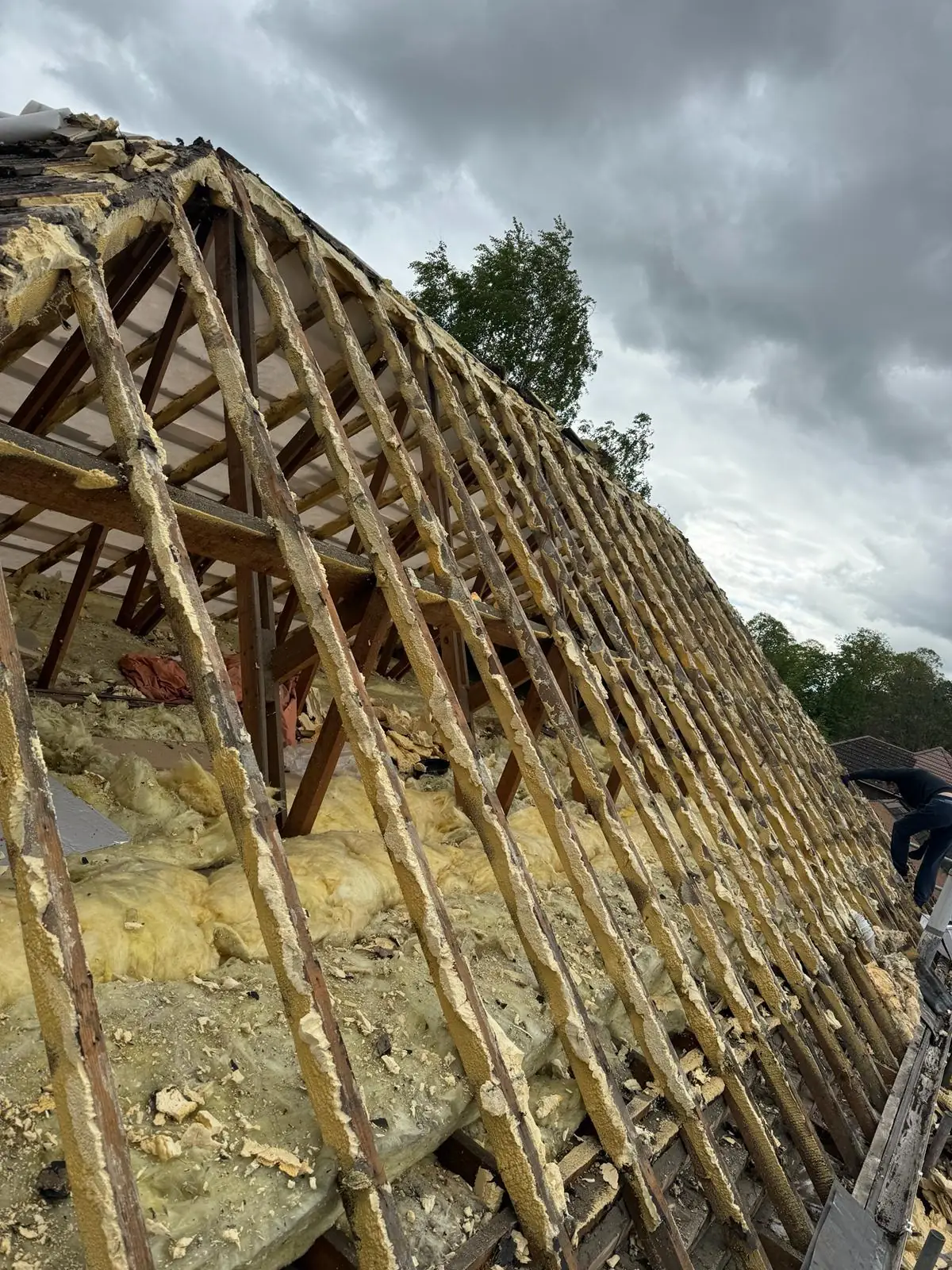
Most modern roofs are designed to draw fresh air in at the eaves, through the soffit, and let it flow up and out through the ridge, keeping the loft space dry and at a stable temperature. Loft insulation pushed too far to the edges, right up against the soffit, is one of the most common causes of blocked airflow, since it seals off the very gap the roof relies on to breathe. Spray foam sprayed straight onto the rafters has the same effect across the whole roof, which is one reason surveyors and lenders now flag it. Our spray foam removal guide covers what taking it out involves.
Missing or insufficient ridge or tile vents
Air has to get out as well as in. A roof without adequate ridge or tile venting can let air in at the eaves with nowhere for it to properly escape, which defeats the purpose of the intake vents in the first place.
Bathroom or kitchen extractor fans venting into the loft
An extractor fan that's ducted into the loft space instead of straight outside through the roof or a wall pushes warm, moist air directly into the one place it does the most damage. This is one of the more avoidable causes, and one of the most common we find on inspection.
Poorly fitted loft hatch
A loft hatch without a proper seal lets warm air from the house rise straight into the loft continuously, adding to the moisture load the ventilation system then has to cope with.
Black mould on the underside of the felt is one of the clearest signs of a long-running condensation problem rather than a one-off event. It builds up gradually where moist air has been condensing in the same spot repeatedly, usually over more than one season.
Does more loft insulation cause more condensation?
Not the insulation itself, but how it's fitted matters. Insulation that's pushed right up against the soffit, blocking the intake vents, is a very common and largely avoidable cause of condensation problems appearing after a loft insulation upgrade. Insulation fitted correctly, leaving a clear air gap at the eaves, shouldn't cause this on its own.
How to stop condensation forming in a loft
- Clear insulation away from soffit vents so air can flow in as intended
- Check for and fit ridge or tile vents if the roof doesn't already have adequate ventilation
- Reroute any extractor fan ducting so it vents outside the building, never into the loft
- Fit a proper seal and insulated cover to the loft hatch
- Have the roof space checked as part of a wider roof inspection if the problem is ongoing
What is black mould on the felt underlay a sign of?
It's the most visible marker of moisture that's been condensing repeatedly against the felt over an extended period, without enough airflow to dry it out between occurrences. It's a sign the ventilation problem has been present for a while, not something that appeared overnight, and it's worth treating as a prompt to actually fix the ventilation rather than just cleaning the mould off.
What happens if it's left unresolved
Condensation left to continue over several seasons doesn't just sit there harmlessly. Timber that's repeatedly damp starts to weaken over time, insulation that gets wet loses much of its effectiveness and takes a long time to dry out, and mould spreads further across the felt and timber the longer the moisture keeps recurring. None of this happens overnight, which is exactly why it's often left unaddressed for years, but it's worth treating as a real maintenance issue rather than something to just keep an eye on indefinitely.
Checking ventilation during other roof work
Loft ventilation is worth checking any time other work is being done on the roof, since it's far easier to correct soffit vents or fit ridge vents while access is already in place than to arrange a separate visit later. This is one of the reasons we check ventilation as standard whenever we're up on a roof for a repair, a re-roof or roofline work, not just when condensation is the specific complaint.
Is loft condensation a leak?
No, and this is worth stressing, because the two get confused constantly. Condensation is a ventilation problem with no roof covering fault involved at all. Fixing it means improving airflow, not patching the roof. Treating condensation as if it's a leak, by looking for and repairing a "leak point" that doesn't exist, wastes money without solving the actual cause.
Swift Roofing checks loft ventilation as part of every roof inspection, and where fascia and soffit work is also needed, we make sure ventilation is corrected at the same time, see our fascia and soffit cost guide. We cover Wisbech, King's Lynn, Peterborough and Norwich.
Want the number for your own roof?
Every roof is different and a guide can only take you so far. A free inspection worth £199 gets you photographs of what is actually up there and a written fixed price, with no pressure to book.
Free roof inspection worth £199
Photographs of what we find, a written fixed price, and no pressure to book.
Straight answers before you book
Why does my loft have condensation?
Almost always because warm, moist air from inside the house is reaching the loft and condensing on the cold underside of the roof, without enough ventilation to let it escape. Blocked soffit vents and missing ridge vents are the most common causes.
Is loft condensation a leak?
No. It's a ventilation problem, not a fault in the roof covering. The two can look similar, damp patches and mould on the underside of the felt, but the cause and the fix are completely different.
How do I stop condensation forming in my loft?
Clear insulation away from soffit vents, make sure ridge or tile vents are fitted and unobstructed, check no extractor fan vents into the loft rather than outside, and fit a proper seal to the loft hatch.
Does more loft insulation cause more condensation?
Not the insulation itself, but insulation fitted right up against the soffit, blocking the intake vents, is a common and avoidable cause of condensation appearing after an insulation upgrade.
What is black mould on the felt underlay a sign of?
A long-running condensation problem, where moist air has been condensing against the same area of felt repeatedly over more than one season without enough airflow to dry it out between times.
Get the ventilation checked properly
We check loft ventilation as part of every inspection, worth £199, and correct it alongside fascia and soffit work where needed. Call 01945 897430 or 01603 851759.
No obligation. No hard sell. We price from a proper inspection, never a guess over the phone.